
GDS Training
Comprehensive GDS Training Guide for Travel Agents: Sabre, Amadeus & Travelport Mastery
From terminal sign-in and availability displays to PNR building, SSR messages, and live ticketing commands
By Project OTA | 30 Sep, 2026 | 8 min read
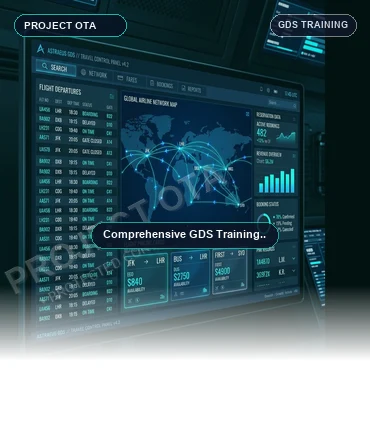
An in-depth guide to GDS training for travel agents: terminal setup, neutral availability, PNR mandatory fields, passport APIS/SSR entries, pricing commands, and live ticket issuing.
1. The Continuing Power of GDS Terminal Mastery in a Digital World
While consumer-facing travel portals rely heavily on graphical user interfaces (GUIs), the backbone of global air travel operations remains rooted in the lightning-fast, command-line Global Distribution System (GDS) environments. Travel management companies (TMCs), consolidators, and retail agencies process millions of complex itineraries daily through cryptic terminal entries in Sabre, Amadeus, and Travelport.
Command-line proficiency allows an agent to bypass sluggish web interfaces, execute complex multi-city fare quotes, manipulate reservation segments, and reissue tickets in seconds. When flight delays, cancellations, or emergency re-routings occur, an agent equipped with deep terminal command knowledge can secure seat inventory and re-ticket passengers long before web-based search engines reflect availability.
2. Terminal Setup, Work Areas, and Flight Availability Searches
Professional GDS training begins with the fundamentals of terminal security and navigation. In multi-access environments like Sabre and Amadeus, agents work across partitioned work areas (Areas A through F in Sabre, Areas A through J in Amadeus). Agents learn mandatory sign-in sequences (such as SI* in Sabre or JI in Amadeus), terminal lock protocols, and duty code authentications to safeguard agency booking queues.
Flight availability search is the operational starting point for any booking. Training guides agents through neutral schedule displays (1[Date][Origin][Destination] in Sabre, AN[Date][Origin][Destination] in Amadeus), 7-day calendar searches, direct airline displays, and filtering by cabin class (First, Business, Premium Economy, Economy). Agents learn how to decode flight status indicators, transit stops, equipment codes, and codeshare operating carrier indicators to advise travelers accurately.
3. Building Compliant PNRs: The Five Mandatory Elements
Every airline reservation rests upon a Passenger Name Record (PNR). An incomplete or improperly formatted PNR risks instant cancellation by airline revenue management robots. In GDS training, students master the essential 'PRINT' protocol—Phone, Received From, Itinerary, Name, and Ticketing Time Limit.
Name entry formats must strictly mirror international passport standards, with distinct syntaxes for adult passengers, accompanied children (CHLD), and infants without a seat (INF). Ticketing field entries (7TAU or 7TAW in Sabre; TKTL or TKOK in Amadeus) ensure that the reservation adheres to airline auto-cancellation deadlines, preventing automated inventory purging before payment confirmation.
Finally, agents learn to conclude reservations using the End of Transaction (ET or ER) entry, generating the six-character alphanumeric GDS record locator alongside direct airline confirmation codes.
4. APIS Passport Documentation, SSR Messages, and Special Services
International civil aviation authorities mandate Advance Passenger Information System (APIS) data prior to departure. A major focus of GDS training is entering Special Service Request (SSR) messages accurately without provoking ticketing rejects.
Agents learn the exact string structures for SSR DOCS (passport number, nationality, date of birth, gender, and document expiry date) and SSR DOCO (visa number, place of issue, and applicable destination country permits). Additionally, students master customer alert entries (SSR CTCM for mobile numbers and SSR CTCE for email addresses) that ensure airlines can directly dispatch real-time gate and schedule change notifications.
The training extends to ancillary services, including specialized dietary meal codes (MOML, VGML, HNML, KSML, CHML) and passenger mobility assistance (WCHR, WCHS, WCHC).
5. Automated Pricing, Stored Fares (PQ / TST), and E-Ticket Issuance
Pricing an itinerary requires a sophisticated understanding of fare construction and airline rule tariffs. GDS training covers lowest-fare shopping entries (WPNCB in Sabre, FXP in Amadeus, FQBB in Travelport) that instantly scan all published and private corporate fare bases.
Once the optimal fare is determined, agents create and store formal passenger pricing records—known as a Price Quote (PQ) in Sabre or a Transitional Stored Ticket (TST) in Amadeus. Training covers price retention, fare breakdown inspection (base fare, fuel surcharges, government departure taxes), and endorsement line verification.
The capstone operational phase is live electronic ticket issuance. Students learn printer designation entries (linking virtual ticketing hardware and invoice queues), executing the issuance command (W¥PQ# or TTP/ET), verifying 13-digit e-ticket numbers, and handling same-day ticket voids (WV / TRDC) to protect agencies from refund penalties.
Frequently Asked Questions
Why do travel agents need GDS command-line training when modern web GUIs exist?
Command-line GDS terminals are significantly faster, more reliable, and offer granular control over complex multi-city routings, waitlist clearances, schedule changes, and manual fare construction that web graphical interfaces simply cannot replicate.
Which GDS system should a travel agency train its staff on first?
Sabre and Amadeus are the two leading global platforms. Amadeus is dominant across Europe, Africa, and parts of Asia, while Sabre is widely preferred in North America, Latin America, and Middle Eastern corporate travel. Travelport (Galileo) is also prominent across specific regional markets.
How long does it take an entry-level travel consultant to become proficient in GDS ticketing?
With structured, hands-on daily training and live practice terminals, an entry-level consultant can master basic PNR creation and flight availability within 3 to 5 days, and achieve confident live e-ticketing and reissue capability within 2 to 3 weeks.
Does Project OTA provide hands-on GDS training for travel agency teams?
Yes. Project OTA offers an intensive 7-day GDS training curriculum covering Sabre, Amadeus, and Travelport. The program includes live terminal command practice, PNR building, SSR APIS entries, stored fare calculation, e-ticketing, ticket voids, and ADM prevention.
Key Takeaways
- Command-line proficiency in Sabre, Amadeus, and Travelport remains the foundation of professional agency ticketing and high-yield corporate servicing.
- Master the five mandatory PNR elements (Name, Phone, Ticketing Time Limit, Received From, Itinerary) to build airline-compliant bookings.
- Execute automated border control messages (SSR DOCS and DOCO) for APIS compliance alongside meal and wheelchair service requests.
- Store passenger pricing records (PQ in Sabre, TST in Amadeus) and issue live electronic tickets with virtual printer designation.
Project OTA delivers comprehensive GDS training covering Sabre, Amadeus, and Travelport—empowering travel agents with practical terminal command mastery, live ticketing skills, and zero-error operational workflows.
Talk to Project OTA