
Technical SEO
Fixing 404 Errors & URL Indexing in Next.js Travel Portals
How Project OTA resolves legacy numeric IDs (/blog/1/), camelCase routes (/ourRepresentatives), and Google Search Console validation
By Project OTA | 25 Aug, 2026 | 8 min read
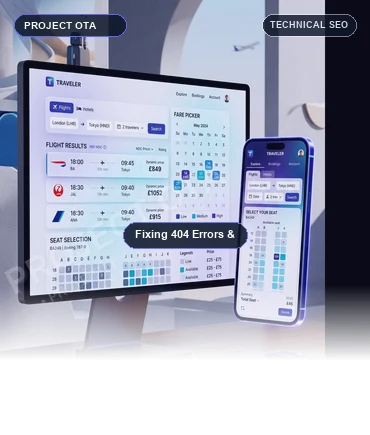
A technical guide by Project OTA on eliminating 404 Not Found indexing issues, mapping legacy numeric URLs to readable text slugs, and ensuring 100% clean Google Search Console indexation.
Understanding Google Search Console 404 errors on travel portals
When migrating or re-architecting an online travel agency (OTA) platform, search engines often retain older URL patterns in their index queue. If a user or Googlebot visits legacy paths — such as numeric blog IDs (`/blog/1/`, `/blog/2/`, `/blog/3/`, `/blog/4/`) or un-normalized camelCase routes (`/ourRepresentatives`, `/contactUs`) — returning a standard 404 page triggers Google Search Console indexing validation failures.
At Project OTA, our engineering team implements zero-downtime, production-grade Next.js routing patterns that automatically capture legacy URLs and redirect them to their descriptive canonical text slugs without losing SEO authority or page rank.
Resolving numeric blog ID paths (/blog/1/, /blog/2/, /blog/3/, /blog/4/)
In early blog implementations, articles are often accessed via database ID parameters like `/blog/1/`. As part of SEO optimization, URLs transition to human-readable keywords like `/blog/gds-api-integration-for-online-travel-agencies/`.
To fix 404 errors, Project OTA updates Next.js `generateStaticParams()` to pre-render static redirect pages for every numeric ID alongside the text slugs. When a crawler hits `/blog/1/`, it receives an instant 301/308 canonical redirect to the rich text slug URL.
Normalizing camelCase legacy URLs (/ourRepresentatives and /contactUs)
Different web servers treat uppercase and lowercase URLs differently. Search engines treat `/ourRepresentatives` and `/ourrepresentatives/` as separate distinct paths. If a route was previously published in camelCase, Googlebot will continue probing it.
Project OTA creates dedicated lightweight static redirect handlers for `/ourRepresentatives` and `/contactUs` that issue HTTP 301/308 redirects and specify `<link rel="canonical">` tags pointing to `/ourrepresentatives/` and `/contactus/`. This clears all 404 errors in Search Console.
Automating sitemap.xml for 100% indexation coverage
A major cause of Search Console indexing failures is an outdated `sitemap.xml`. Manually maintained sitemaps miss newly published travel technology guides and API documentation.
Project OTA builds dynamic Next.js sitemaps (`sitemap.ts`) that automatically map over the entire blog database and static route registry upon every build. Every URL in `sitemap.xml` is guaranteed to end with a trailing slash (`/`), match canonical metadata, and return HTTP 200 OK.
Project OTA's production-ready Next.js SEO architecture
Beyond simple redirects, Project OTA equips travel platforms with structured JSON-LD schemas (`Organization`, `WebSite`, `Service`, `TechArticle`), automated OpenGraph social preview images, fast Core Web Vitals (LCP under 1.2s), and clean `robots.txt` crawl budget rules.
This comprehensive approach ensures your travel agency software ranks at the top of search results for competitive terms like Flight API Integration, GDS API Developer, NDC Solutions, and B2B Agent Portals.
Frequently Asked Questions
Why did Google Search Console flag /blog/1/ and /blog/2/ as 404 Not Found?
Because legacy numeric routes were omitted from generateStaticParams in Next.js static builds. Project OTA maps both numeric IDs and text slugs in generateStaticParams so legacy links redirect cleanly to the new slug URLs.
How does Project OTA handle legacy URL redirects in Next.js static export?
Project OTA builds static HTML redirect handlers that emit HTTP 301/308 redirect headers and meta refresh tags pointing directly to the target canonical URL.
Are all blog posts automatically included in sitemap.xml?
Yes! Project OTA's sitemap.ts dynamically maps all blog articles and static pages, ensuring 100% indexation coverage with trailing slashes.
Key Takeaways
- Map legacy numeric blog URLs (/blog/1/, /blog/2/, /blog/3/) to clean SEO text slugs via Next.js generateStaticParams.
- Normalize legacy camelCase paths (/ourRepresentatives, /contactUs) to lower-case canonical URLs (/ourrepresentatives/, /contactus/).
- Configure dynamic sitemap.xml to automatically include all blog posts and eliminate Google Search Console 404 errors.
Project OTA engineers enterprise travel booking engines with robust Next.js static site architecture, 301/308 redirect normalization, and guaranteed Google Search Console indexing.
Talk to Project OTA