
Travel Business Consultancy
Starting an Online Travel Agency: The Complete Business Consultancy and Launch Roadmap
From legal entity formation and IATA accreditation to API selection, Capex planning, and go-to-market execution
By Project OTA | 30 Sep, 2026 | 9 min read
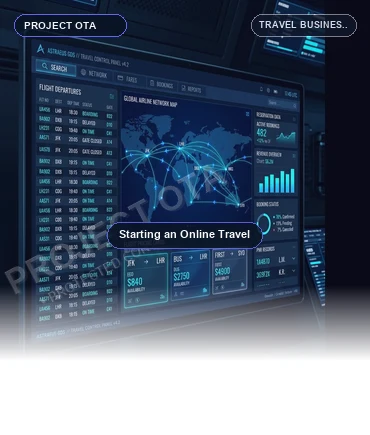
A master roadmap for travel entrepreneurs: entity formation, licensing, choosing between IATA vs Non-IATA consolidator models, booking engine tech stacks, and working with expert OTA consultants.
1. The High-Stakes Reality of Launching an Online Travel Agency
The global online travel market represents a multi-trillion dollar opportunity, driven by booming leisure travel, corporate mobility, and digital booking habits. However, launching a successful Online Travel Agency (OTA) involves far more than simply launching an attractive website with a search bar.
Industry data reveals that nearly 70% of new travel technology ventures encounter severe operational hurdles within their first 18 months—not due to lack of customer demand, but due to flawed accreditation choices, miscalculated payment gateway reserves, volatile API look-to-book ratios, and supplier contract mismanagement. Engaging specialized travel business consultancy before committing capital is the single most effective way to eliminate blind spots and ensure a high-ROI launch.
2. Corporate Entity Structuring, Licensing, and Bank Guarantees
Before applying for airline inventories or integrating payment processors, founders must establish an appropriate legal corporate structure. In most jurisdictions, selling commercial passenger travel requires dedicated travel agency licensing issued by national tourism departments or civil aviation authorities (such as ATOL in the UK, Seller of Travel licenses in the US, or Ministry of Tourism approvals in Asia and the Middle East).
Furthermore, commercial banks evaluate travel agencies under strict high-risk merchant categories. An experienced travel business consultant guides founders through establishing dedicated merchant trust accounts, preparing audited financial statements, and structuring required local security deposits or insurance bonds.
3. Navigating the Accreditation Dilemma: IATA GoStandard vs. GoLite vs. Consolidator
One of the earliest and most consequential strategic crossroads for any aspiring OTA is selecting an airline distribution model:
IATA GoStandard: The traditional gold standard accreditation granting direct cash ticketing authority across all IATA BSP participating airlines. However, GoStandard demands significant financial audits, qualified ticketing staff, and substantial bank guarantees that can lock up $50,000 to $250,000+ in restricted liquidity.
IATA GoLite: A modern, low-collateral alternative that permits credit card ticketing (IATA EasyPay and customer cards) with reduced financial liability and zero or minimal bank guarantee requirements.
Non-IATA Consolidator Model: For early-stage startups, partnering with an established wholesale B2B consolidator or host agency offers the quickest path to market. The startup accesses wholesale net fares and ticketing fulfillment via API or shared PCC without tying up capital in IATA bonds. Professional consultancy helps agencies calculate the exact tipping point where transitioning from consolidator to direct IATA accreditation maximizes profitability.
4. Architecting Your Booking Engine Tech Stack: Custom vs. White-Label
Technology represents both the primary engine of agency growth and its largest capital investment. Founders must choose between pre-built white-label SaaS solutions and bespoke custom travel portal development.
While white-label portals offer rapid 30-day deployment, they restrict branding, charge ongoing transaction royalties, and trap agencies inside closed technical ecosystems. Conversely, custom-engineered booking engines (such as those developed by Project OTA) provide complete ownership of source code, seamless multi-provider aggregation (normalizing Sabre, Amadeus, Duffel NDC, and hotel beds), proprietary dynamic markup rules, and enterprise-grade SEO landing pages.
5. The 90-Day Pre-Launch and Post-Launch Operational Playbook
A successful OTA rollout demands an integrated, 90-day execution roadmap. The pre-launch phase involves sandbox API end-to-end booking verification, automated payment gateway chargeback testing, fraud detection configuration (3D Secure 2.0), and ticketing queue routing setup.
Once live, operational focus shifts toward customer acquisition cost (CAC) optimization, Google Flights and meta-search integrations, organic SEO content publishing, and round-the-clock customer support desk readiness. Professional consultancy provides founders with weekly operational reviews, key performance indicator (KPI) dashboards, and commercial negotiation support to steer the business toward rapid break-even.
Frequently Asked Questions
How much capital is required to start a scalable Online Travel Agency?
Depending on the operational model, an entry-level OTA operating under a consolidator API model can launch with $25,000 to $50,000 in working capital. In contrast, a fully accredited IATA GoStandard agency with custom software and bank guarantees typically requires $100,000 to $250,000+.
Do I need an IATA license to start selling flight tickets online?
No. Many successful online travel agencies operate as Non-IATA agencies by integrating B2B consolidator APIs or host agencies that issue tickets on their behalf while the agency focuses on marketing and brand building.
What is included in Project OTA's Travel Business Consultancy package?
Project OTA's $1,000 consultancy package includes up to 3 months of hands-on advisory covering travel agency entity setup, IATA accreditation pathways, Capex/Opex financial modeling, GDS segment incentive strategies, technology stack evaluation, and operational SOPs.
How long does it take from consultancy kickoff to live OTA platform launch?
A typical deployment timeline spans 60 to 90 days, encompassing entity registration, supplier API credentialing, custom portal frontend/backend engineering, payment gateway onboarding, and end-to-end sandbox flight testing.
Key Takeaways
- Discover the critical legal, regulatory, and financial steps required to start and scale a sustainable Online Travel Agency (OTA).
- Evaluate the commercial trade-offs between IATA GoStandard, IATA GoLite, and working under a licensed B2B Consolidator.
- Understand the realistic capital requirements: technology development (Capex), GDS deposits, payment gateway reserves, and initial operational burn (Opex).
- Architect a robust technology foundation combining GDS flight APIs, NDC direct connects, and global hotel aggregators.
Turn your travel startup vision into a thriving digital enterprise. Partner with Project OTA for comprehensive travel business consultancy, strategic financial modeling, and cutting-edge booking engine development.
Talk to Project OTA